
Lately we’ve seen many Odoo partners take interest in Frappe. Many of then have been working on Odoo for more than a decade but they are now unhappy, because their customers aren't happy. Odoo’s price increase has affected their customers and slowed down their sales. I heard a story of one such customer in Africa, they spent a year implementing Odoo and even before they could use it properly, it was time to pay more, not because their users grew, or their usage grew, just because there was an increase in the price per user. They felt cheated as their planned budgets went for a toss. Since then I’ve been reading about the frequent price hikes.
The price hike started in selective markets like the US in January 2026, but now it is happening across the board. The price has increased by 20%. Customers are forced to upgrade and pay higher, and if they don’t they have to pay extra to avail legacy version support. Customers don’t have a way out of this lock-in.
Recently Odoo also introduced a way to tax “light users”. These users could be employees, vendors, customers or any others who don’t need to have access to the core application and might need to access a web portal for self-serve use cases. ERPNext calls them portal users. Odoo customers will now have to pay extra for such users.
The Odoo customers that came for a promise of open source must be heavily disappointed and rightfully so. They cannot derive any benefits that they probably expected from open source like more control, flexibility, no lock-in and affordability. Why? Because Odoo is NOT open source.
Odoo makes money from their “enterprise edition” which is closed source. Investors smartly call this “open core” business model but that’s just open-washing. Odoo’s community edition has very limited features and excludes some of the most fundamental features like accounting.
Not only is Odoo not open source, they’re also not affordable. Their enterprise edition does not start from INR 580 / USD 30 / month for all apps, which is what their marketing claims.
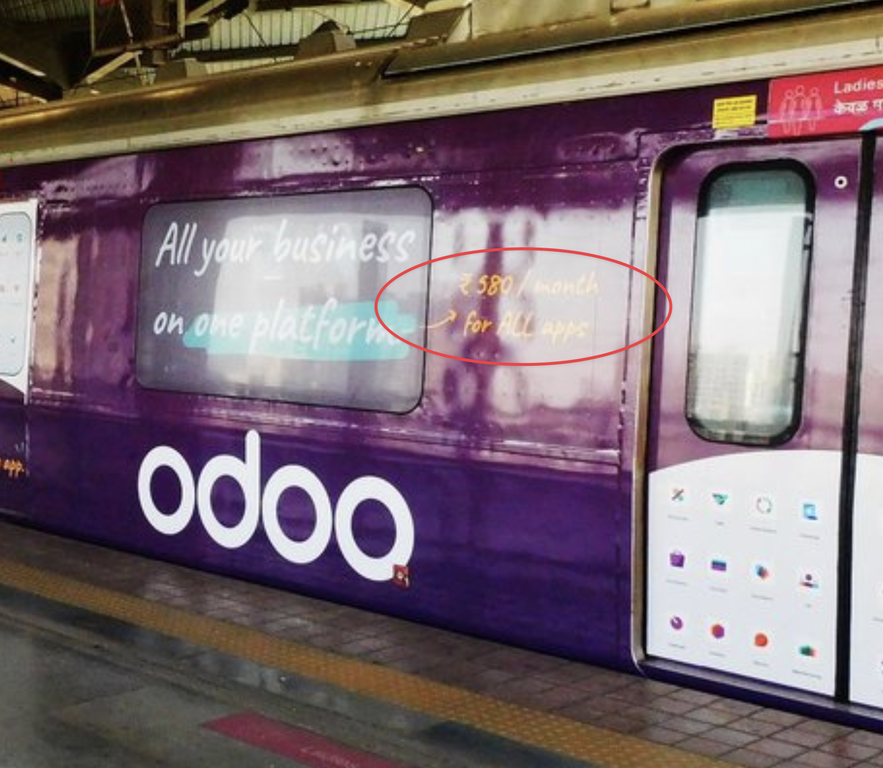
Misleading advertising
These ads are appealing, but misleading too. Because they conveniently forget to mention “per user” which is an important variable in their pricing. This is visible as soon as you land on their website.
.png)
The real price
There’s more! ₹580 / USD 30 is only for the year 1 as a special discount, you start paying ₹725 per month from second year.
Some would argue that ₹725 per user is still affordable compared to Zoho One, SAP, and the Microsoft Dynamics of the world.
But is it really? Let me peel the onion further. Even with ₹725 / USD 38 per user you get Odoo Online, which is an extremely stripped down version of Odoo. It is the base, vanilla product with limited features, no API integrations, no customisations, no marketplace apps. Nothing. So, it isn’t fair to compare Odoo online with SAP / Zoho.
The real pricing: ₹1,350 / USD 61 per user per month
This is what you pay to get any meaningful benefit from Odoo software. That is a lot for any small business to afford. To put things in perspective, a 50 employee organisation will have to pay ₹67,500 / USD 3000 per user per month.
While you make peace with this, there’s more! Licensing fees are separate from hosting fees. Odoo charges you separately for their Odoo.sh hosting.
Now comes the final dent in your bank: Odoo.sh
Every software has to be hosted on a cloud to be accessible over the internet and for that Odoo offers Odoo.sh. The pricing for Odoo.sh is separate from the per user licensing fees. Odoo.sh hosting pricing is expensive. The pricing variable aren’t exactly comparable to AWS / GCP or Frappe for that matter so it is difficult to make a direct comparison. But most developers find it expensive.
More lock-ins, and push to longer commitements
Odoo is making more users move to annual commitments. Odoo’s pinky promise for their annual customers is that, the price increased will be capped to 7% per year. Which means if you’re on a monthly plan, Odoo can raise prices any time, any how, but not if you’re on an annual plan.
So, Odoo’s promises of no vendor lock-in and no long term contracts doesn’t seem true either.
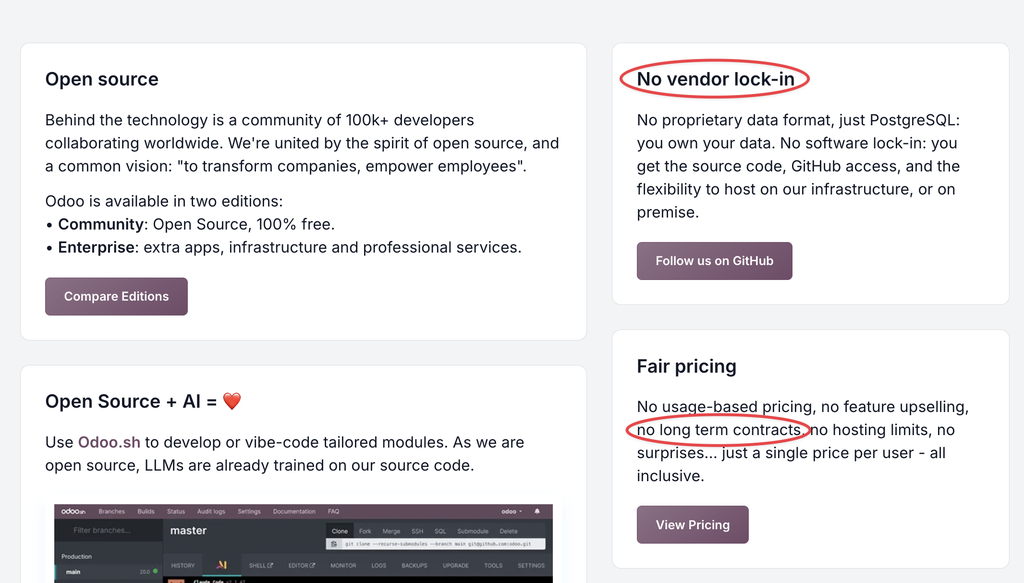
Open Source ≠ Freemium
Odoo’s strategy relies on growing the top of the funnel with marketing blitz, free and affordable limited features and monetising when customers grow their usage. And their recent price increase likely ties back to their need for better unit economics. This isn’t necessarily a problem.
But sorry to break this to you Odoo, open source ≠ freemium. Customers will eventually know about the open-washing. Because enterprise editions, price increase, lock-ins, and rigid rules are exactly the opposite of open source. Customers deserve to know this, sooner than later.
Frappe’s approach
At Frappe, we don’t believe open source ≠ Freemium. Open source should have no exceptions. None of the Frappe apps and features are hidden behind “enterprise editions”, and yet it leaves us enough ways to make money, grow at 50% YoY, profitably.
When it comes to marketing. Odoo burns over hundred million dollars on marketing in digital ads, billboards, paid influencer marketing, but guess what - ERPNext alone manages to get 8-10% of Odoo’s traction, without any paid marketing. It is purely on the back of a good product, word of mouth, and a developer community built over years. This traction excludes the growing interest in the new apps (Frappe CRM, Helpdesk, Learning, Builder) and the Frappe Framework itself.
India Odoo vs. ERPNext
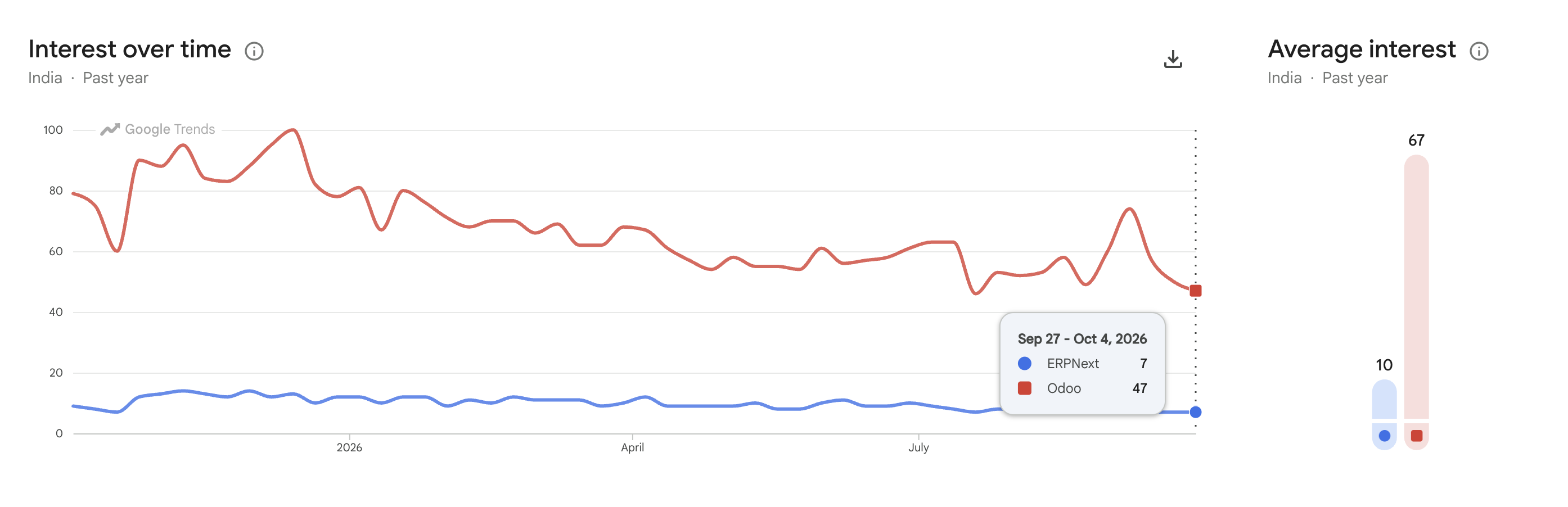
Global Odoo vs. ERPNext
.png)
Don’t get voodooed and stop paying per-user!
When you use Frappe, there is no "per user" pricing. There is no user, let alone light user. No per-user fees means you don’t pay any licensing fees for any of the Frappe apps. The apps are truly free and open source.
| Odoo Online | Odoo Custom | ERPNext | |
|---|---|---|---|
| Licensing Fees | $38 per user per month | $61 per user per month | $0 (no licensing fees) |
But you need to host your apps somewhere and that is where Frappe Cloud comes in. Frappe Cloud is Frappe's own cloud hosting platform. Here’s how Odoo’s pricing compares with Frappe’s for 10, 50, 100, 500 users.
| Users | Odoo Online | Odoo Custom + Odoo.sh | ERPNext + Frappe Cloud |
|---|---|---|---|
| 10 | $311 | $610 + ~$72 = ~$682 | $0 + $25 = $25 |
| 50 | $1,555 | $3,050 + ~$130 = ~$3,180 | $0 + $25 = $25 |
| 100 | $3,110 | $6,100 + ~$245 = ~$6,345 | $0 + $200 = $200* |
| 500 | $15,550 | $30,500 + ~$667 = ~$31,167* | $0 + $300 = $300* |
*It is difficult to make an accurate guess for the hosting prices based on # of users, both for Odoo.sh and Frappe Cloud. Here we assume that a $200/mo and $300/mo dedicated server plan can take up 100 and 500 users which may not exactly be true if you have high transaction volume and concurrent users.
The real power of open source is affordability
One of the huge benefits of open source is affordability and that is what we aim to give our users. In fact, we’re working towards dropping our prices even more every year.
In the upcoming Frappe Cloud version II, which is going to offer a general purpose hosting beyond Frappe, the price will be VM based pricing and highly competitive. Stay tuned for more updates on this.
The journey has been slow and patient. But the mission of slaying the SaaS industry isn’t going to happen overnight. Businesses are taking time to notice the power of open source, especially the non-technical decision makers. But the day they see it, they will not be able to un-see it. Investors have been talking about how AI is leading to SaaSocalypse, but we at Frappe have been already disrupting the market with high quality open source software and we have only just scratched the surface.
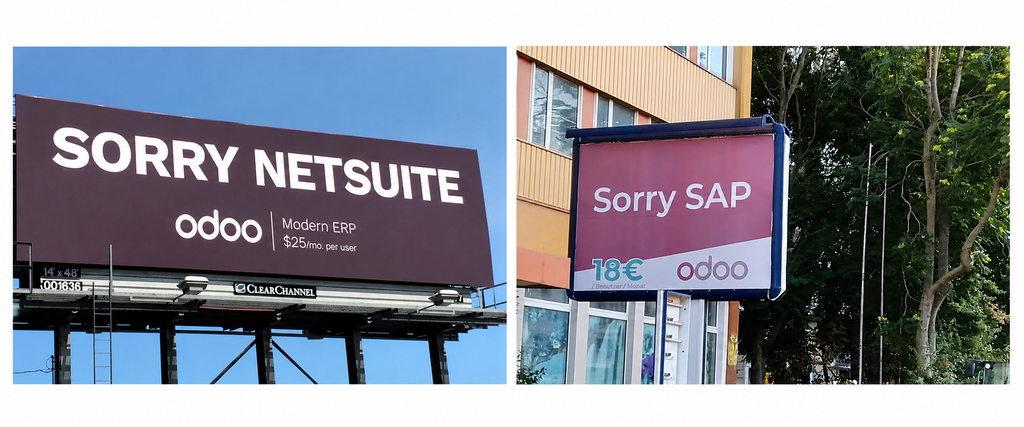
Sorry NetSuite: image from Oleg Kuryan’s public LinkedIn post; Sorry SAP: image by much.
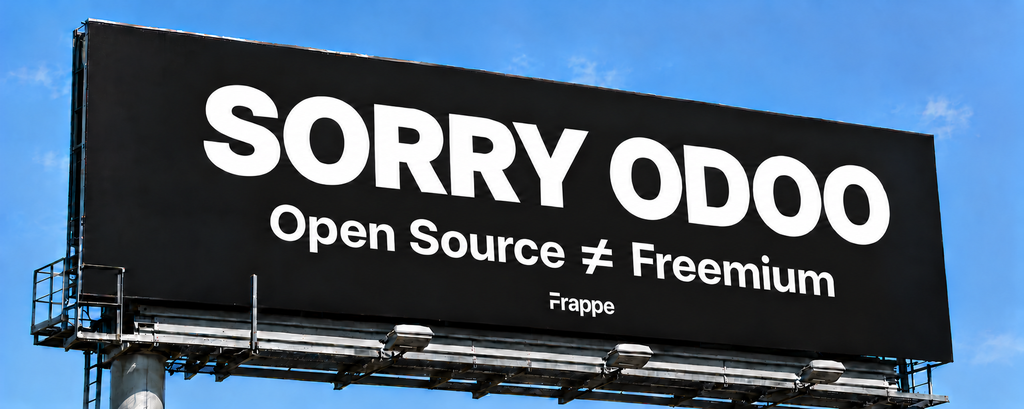
So, while Odoo is going around adding billboards apologising to SAP and Netsuite about their lower per-user pricing, here's our message to them.