

When you work in an open-source setup, you will see how easily stories stem from different sources. I see stories of business use cases, out-of-the-box solutions or even stubborn old systems adapting to new software and apps. A whole bunch of builders (and partners) inside the Frappe ecosystem keep shipping new features every day using ERPNext and Frappe for themselves or their customers. Most of these implementation stories stay between the two parties, unless there’s a place to show them off.
Public Webinars started as a way to present these ideas outside their usual circles, where partners could share what they build and the community could ask whatever they want. From the outside, a webinar looks just as simple as picking a topic, sharing a link and talking for an hour. By the time I host one, it has already moved through eight different steps just to get one published. Proposals come in from partners and community members across regions. Sessions are arranged to fit different time zones, languages, and topics of mass interest. Registrations happen through a public form. The recordings end up on YouTube so the conversation can reach more eyes. We run several webinars every month, and I can tell, no two feel the same.
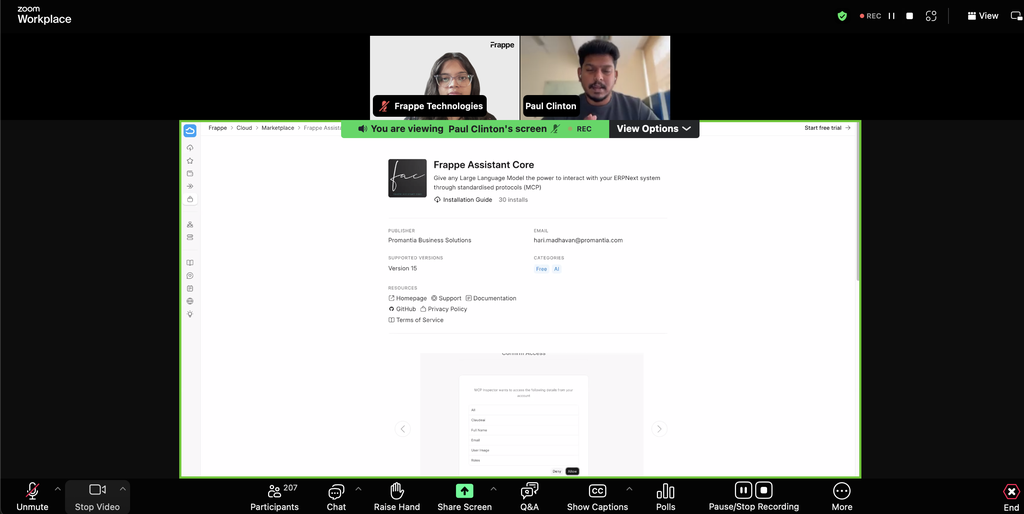 In case I host you next, things might look like this
The topics covered here are as broad as the ecosystem. Partners, community folks, contributors, and everyone central to Frappe come together on this space with knowledge as the only base. We’ve had sessions on everything you can imagine: Retail, manufacturing, payroll, accounting, human resource, enterprise, CRM, education and AI to name a few larger ones. Originally, it was mostly our speakers showing demos of new features or apps they built on Frappe. But very recently, we started hosting long, candid chats with partners and their customers, where they spill what working along is really like with all the ups and downs in between. While at it, a few of our partners used this platform to launch their apps live.
Our audiences come with a lot more background. The platform has seen owners of startups, flower farms, pet shops to established entrepreneurs in niche products like period care, and eco-friendly goods. We’ve also shared this space with people from NGOs and similar social volunteers. Not just founders, the session is also an entry point for interested users to take a look at what we are building. Many developers, consultants and advocates of open source use this space to either learn from the speakers or tell us their part of struggle which is the whole point of hosting public webinars.
Attendance swings wildly. Our tiniest crowd was 12 and the biggest peaked to nearly 300 (292 to be exact). Sure, the delta is way too big to scratch my head over, but with time I saw that there’s no single reason for it. Timing matters. Language matters. The problem being discussed matters. While most attendees are from India, I love seeing small crowds joining from far-off regions for German or Burmese webinars. A smaller crowd feels equally alive when a few of them stick around and keep firing questions.
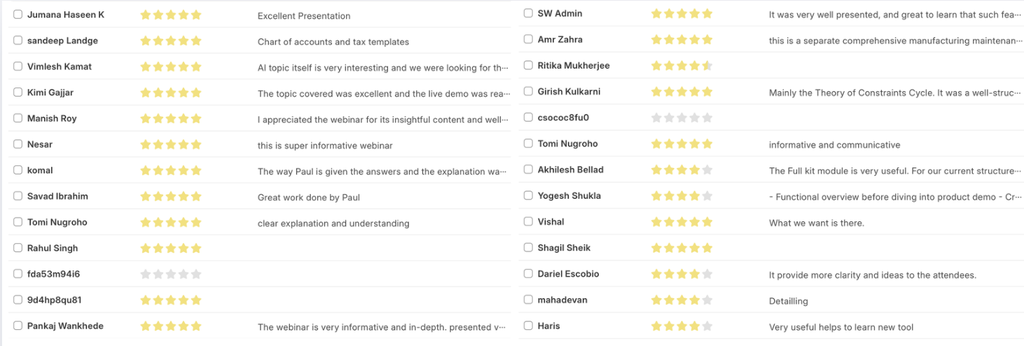 Feedback for the win
If there is one thing about doing webinars, it’s that good preparation helps. That said, no amount of preparation can fully prepare you for the unexpected. I still remember in one of my early days of hosting, everything that could go wrong, did. The mics didn’t work, the slides barely loaded, and neither of us could be heard by the attendees and I was sitting there with 40 people watching me grin through the panic. I think I wrote “let’s give it a few seconds,” at least 3 times in the chat. After seven minutes of max confusion, we somehow got it working and the session went nearly fine. The very next day, we had a Stock and Manufacturing webinar run by one of our partners. You could tell the session felt different from the very first minute. The air had this easy confidence to it, the demo was buttery smooth. Once the presentation was done, the QnA box exploded. Raised hands everywhere on the screen and people firing questions. (This contrast always keeps me wondering who’s learning more, me or the audience?)
Over time you start noticing patterns, familiar faces, recurring names in the attendee list. We’ve had partners from so many regions conduct webinars that I’ve honestly lost count. So far, I’ve had the bonus to host over 35 sessions. Pretty soon, it was easy to tell which topics grab the most attention and that also says which features are in the interest of the viewers. Watching sessions in Arabic, Burmese, German… and seeing people bond over ERPNext, open source, and telling their stories has been one of my favourite parts of hosting webinars yet.
People at Frappe always seem to have a soft spot for “the community” and webinars gave me a closer window into it. I might not say the view outside the window is always perfect but it’s good enough to keep me coming back every time. And if that’s not all, it’s simply knowing someone, somewhere on the other side of screen is trying out a few ideas from these sessions for themselves.


·
That's a beautiful introduction into webinaring beyond the videotechnical aspects, touching the adventure-like aspect of a bouquet of people sharing their colors and fragrances, their respective bits of ideas and doubts and lights, which make it so useful and touching. 🙏